This content was originally published by the Longmont Observer and is licensed under a Creative Commons license.
The Regulated Metro District
Part 2 of 2 Parts
A funny thing happened on the way to Affordable Housing. Longmont found a formula that appears to solve a much older problem. It involves a financing tool called Residential Metropolitan Tax Districts which were described in Impact Longmont last week.
That older problem may be the root cause of why so many
people I work with have a deep-seated dislike of real estate developers. Now, I
understand that there can be some natural resentment of people whose business
is profitable. But this business isn’t always profitable: developers lost
big-time in the housing bust, just like we did. The Longmont developers I know
are a good bunch: one’s a philanthropist, two more are environmentalists, and a
fourth volunteers many hours for our public housing nonprofits. There are a
couple of absentees who don’t mow their weeds, but hey, there’s a bad apple in
every barrel.
Recently, an industry analyst I know explained how the
dynamics of the construction industry are out of whack in most places. The
developers of horizontal infrastructure, like water, sewers, and roads, usually
make out okay. The homebuilders that depend on developers to prepare building
sites just barely get by. And the other stakeholders, who are the municipality
and its residents, aren’t consulted much about what is built, beyond following
zoning rules and picking out countertops. That imbalance could easily stir up
some resentment.
[Note – that dynamic is NOT the rule in Longmont today,
generally. Our developers and our Economic Development Partnership both work to
make it otherwise. But it takes a long time to forget history.]
Photo by Dawid Małecki on Unsplash .
Serendipity in Longmont
During 2017-2018, Longmont’s City Council and Staff worked
together to construct a package of ordinances meant to solve our growing
housing crisis. The Affordable Housing Ordinance requires 12% of the housing
units constructed in a project to be permanently affordable. Or if not, a fee
becomes payable to the City, used to fund public housing or assistance to
residents who are housing-burdened. That fee is graduated, so that market-rate
housing attainable to homebuyers below the average income in the area doesn’t incur
the fee. More expensive homes owe a fractional fee, until housing only people
earning 20% or more over the area
median can afford pays the full fee.
To offset this extra cost of developing and improving real estate, we added a package of incentives calculated to lower the cost of borrowing in the construction industry. Allowing Residential Metro Districts is part of that package. Before these changes, pretty much the only housing being built was aimed at people earning 120% the Area Median Income or more. In other words, it was accessible only to tech workers with six-figure-plus incomes, fleeing Boulder for our lower prices and better lifestyle. Now Longmont’s housing stock is diversifying. The average sale price is dropping even in the face of a good economy. That was the expected result. The unexpected result is even better.
Here’s the funny thing:
To create developments that comply with Longmont’s
ordinances, the land developer and the builders must collaborate. Developers
are well advised to seek partnerships with builders early in the process,
rather than selling developed parcels to anyone who will buy. This gives construction
companies more leverage as a stakeholder.
Now developer-builders are looking at the city’s incentive and
fees package, designing neighborhoods that match the city’s published vision so
the end product will qualify for as many incentives as possible. These
incentives increase profitability, offsetting the new fees, and also reduce
risk. Risk is the real fear of entrepreneurs in the construction industry: it’s
possible to recover when profits are less than expected, but a big loss can put
you right out of business.
A municipality like Longmont considers the city’s
demographics carefully when planning. Its policies are presented to the public
at open meetings, fairs and other public events, and in surveys before they are
finalized. So the goals of the City for development are giving a voice not only
to the city government but to the residents of the city.
This is the serendipity: now all four stakeholder groups
have a strong voice in the process.
Keeping it good
Despite these benefits, the Longmont City Council is, at the urging of a group of influencers in the city, considering a repeal of the ordinance that allows the Council to create Metro Districts. Like repealing the Individual Mandate in the Affordable Care Act, taking out this key element weakens the whole package.
To me, this is removing one’s nose to spite one’s face. Why repeal a statute that’s been in effect for under a year? Only one development has been approved so far, and it's hard to argue that one is too costly, lacks justification for its mill levy, or fails to advance the city’s vision. It’s giving us the Veteran’s Village, 8 Habitat Homes, additional low cost housing. It will relieve congestion on Rogers Road and Hover, and extend our Greenway network. It has contractual limits to keep homeowner costs under control. What’s not to like?
Metro Districts need regulation, not elimination. Here’s how
to do it:
Constrain the City Councils (now and future)
We can require by statute that the Council may only approve
a Metro District Service Plan that reinforces the goals in the City’s
Comprehensive Plan, Sustainability Plan and Work Plan. Service Plans that
propose to use the advantages of Metro Districts for other things not only
won’t be approved, they can’t be
approved.
Here’s an easy example: suppose a
developer brought forward a concept plan for a gated community of ¾ acre lots
with McMansions selling at $1M and above, with a private clubhouse, pool, and
tennis courts not open to the public.
Should the Council be able to approve a Metro District to assist that
developer with financing such a community? Absolutely not! Exclusivity is not our
goal in Longmont!
Longmont must pass an ordinance
limiting the use of Metro District financing to concept plans which exceed a
certain density threshold. The average price of homes in the District must
remain below a level that is computed relative to the Cost of Living Index or
the Area Median Income. [The city’s planning staff can work out the best
measure.] Longmont’s Affordable Housing Ordinance already works this way when
computing how credits and fees are assessed to builders – and it is very
successful. These are a few examples of how statutory limits on what kind of
Districts may be approved can ensure that Metro District financing is only used
in the overall best interests of the city.
Control Costs and Transactions
Think of the Metro District Service Plan as a dashboard for the District. It has switches and knobs that the Board of Directors can use to adjust the monetary and operational state of the District. But by means of city ordinances, Longmont can control how far we let those knobs turn. Here are some properties of Metro Districts that can be controlled by statute:
Mill Levy
Cap. The Mill Levy is the rate at which properties in the District are
taxed, in addition to the state and local property taxes. The Board of
Directors of a Metro District can raise and lower the Mill Levy. But if the
Mill Levy is capped in the Service Plan, then a homebuyer knows that their
District mill levy will not increase beyond a certain point. And the Council must be constrained from
passing a Service Plan that doesn’t contain such a cap.Debt.
A Metro District’s future tax revenue stream can be used to secure a bond
issue. This is the main advantage of a Metro District, because the bond
interest rate will generally be lower than the primary construction loan’s.
This saves the developer money. It saves money for the builder who buys lots in
the District. That in turn allows the
finished homes to be offered at a lower price. Once again, the Council can be constrained by law to only approve service plans
that cap their own ability to incur debt via bonds. Boards must get
permission of the Council to change their Plans, and the councils are subject
to constraints as to what they can approve.
Empower the Homeowner
Every Metro District has a 5-7 person Board of Directors
that governs its finances and operations. The Board must be comprised of
property owners or residents of the District. At first, this usually means only
developers and other investors are qualified. Directors only serve for a fixed
term of years, and then must be replaced or re-elected. Districts start out
with term limits, though according to the Colorado Department of Local Affairs,
“the vast majority” of Metro Districts vote to waive term limits.
Homeowners (and tenants) always have a chance to elect board
members from among their ranks. This puts a check on development professionals
who might be more concerned with recovering their capital or earning interest
on it, than for the well-being of the District Residents.
Whether or not term limits are an important factor, it will
be important to ensure that residents of Metro Districts know their voting
rights. Longmont can go beyond what is required by the state statutes to educate
voters who live in Metro Districts, help them obtain canvass lists, and
otherwise take control of their future as engaged citizens.
Use Model Plans
One objection to Metro Districts is the amount of work it
takes for the Staff and Council to approve them and to oversee them. Here,
standardization is the answer.
Other successful municipalities, such as Parker and Colorado
Springs, have brought down the cost of managing their special districts by
requiring all applications to use one of a small number of model Service Plans.
This saves work for everyone: the applicants can just fill in the blanks with
what they want, and the City can use a standard evaluation process to determine
if the resulting Plan is acceptable.
It took an estimated 137 hours to review and approve the
Mountain Brook Service Plan – our first. With Model Plans, this number should
be reducible to 10 or 20 hours – a bargain!
Exercise Oversight
Periodically, the Council must review the regulations on
Metro Districts to take experience and alterations in the city’s Plans into
account. Municipal policies change, and those policies should dictate what kind
of development can be incentivized.
Tying limits to automatically updated metrics such as the
Area Median Income or the Prime Interest Rate can reduce the frequency with
which ordinances must be updated. The review cycle can be tied to other
periodic reviews such as land use code updates.
The Planned City
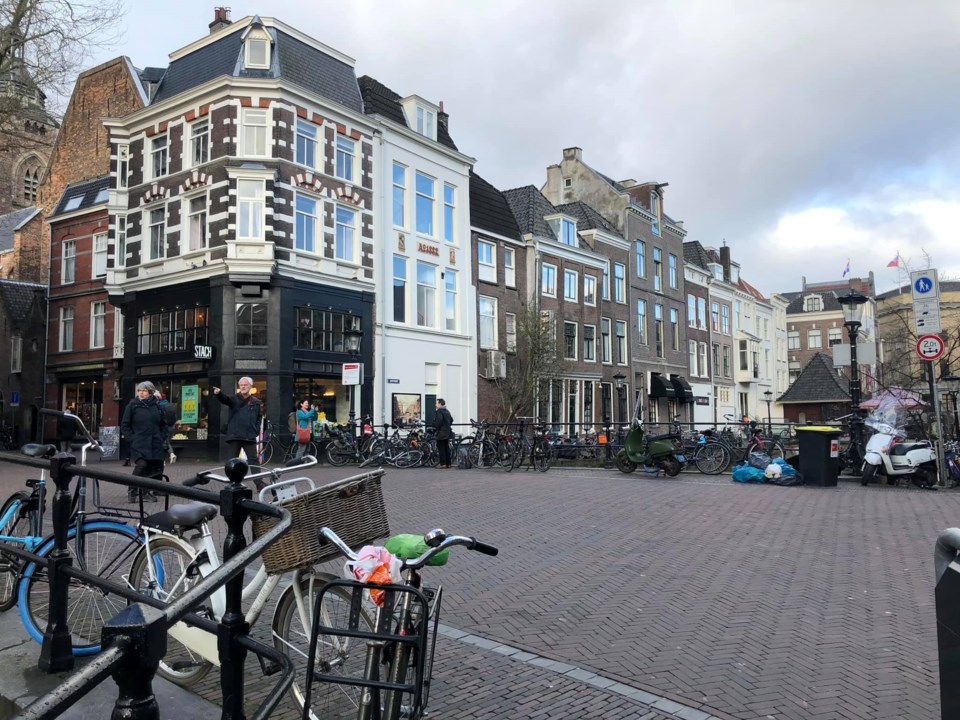
Ever wonder why European cities are so beautiful? Whether
they are old or new, they’re not US towns. Remember how much destruction those
cities suffered during WWII? In many places, Europe started over (with a plan).
Utrecht, Netherlands. Photo by Tim Kiefer. Used by permission.
The big, rich, confident USA never suffered that destruction, and we didn’t think we needed a plan. Now we have constraints of wealth, space, and climate change. Now we need a plan. Let’s not try to make our plan without a T-Square, Ruler, or Compass. Let’s use our best incentive to get the developers and builders working with each other, with us, and for us. The result will be beautiful.
This content was originally published by the Longmont Observer and is licensed under a Creative Commons license.
The Regulated Metro District
Part 2 of 2 Parts
A funny thing happened on the way to Affordable Housing. Longmont found a formula that appears to solve a much older problem. It involves a financing tool called Residential Metropolitan Tax Districts which were described in Impact Longmont last week.
That older problem may be the root cause of why so many
people I work with have a deep-seated dislike of real estate developers. Now, I
understand that there can be some natural resentment of people whose business
is profitable. But this business isn’t always profitable: developers lost
big-time in the housing bust, just like we did. The Longmont developers I know
are a good bunch: one’s a philanthropist, two more are environmentalists, and a
fourth volunteers many hours for our public housing nonprofits. There are a
couple of absentees who don’t mow their weeds, but hey, there’s a bad apple in
every barrel.
Recently, an industry analyst I know explained how the
dynamics of the construction industry are out of whack in most places. The
developers of horizontal infrastructure, like water, sewers, and roads, usually
make out okay. The homebuilders that depend on developers to prepare building
sites just barely get by. And the other stakeholders, who are the municipality
and its residents, aren’t consulted much about what is built, beyond following
zoning rules and picking out countertops. That imbalance could easily stir up
some resentment.
[Note – that dynamic is NOT the rule in Longmont today,
generally. Our developers and our Economic Development Partnership both work to
make it otherwise. But it takes a long time to forget history.]
During 2017-2018, Longmont’s City Council and Staff worked
together to construct a package of ordinances meant to solve our growing
housing crisis. The Affordable Housing Ordinance requires 12% of the housing
units constructed in a project to be permanently affordable. Or if not, a fee
becomes payable to the City, used to fund public housing or assistance to
residents who are housing-burdened. That fee is graduated, so that market-rate
housing attainable to homebuyers below the average income in the area doesn’t incur
the fee. More expensive homes owe a fractional fee, until housing only people
earning 20% or more over the area
median can afford pays the full fee.
To offset this extra cost of developing and improving real estate, we added a package of incentives calculated to lower the cost of borrowing in the construction industry. Allowing Residential Metro Districts is part of that package.
Before these changes, pretty much the only housing being built was aimed at people earning 120% the Area Median Income or more. In other words, it was accessible only to tech workers with six-figure-plus incomes, fleeing Boulder for our lower prices and better lifestyle. Now Longmont’s housing stock is diversifying. The average sale price is dropping even in the face of a good economy. That was the expected result. The unexpected result is even better.
Here’s the funny thing:
To create developments that comply with Longmont’s
ordinances, the land developer and the builders must collaborate. Developers
are well advised to seek partnerships with builders early in the process,
rather than selling developed parcels to anyone who will buy. This gives construction
companies more leverage as a stakeholder.
Now developer-builders are looking at the city’s incentive and
fees package, designing neighborhoods that match the city’s published vision so
the end product will qualify for as many incentives as possible. These
incentives increase profitability, offsetting the new fees, and also reduce
risk. Risk is the real fear of entrepreneurs in the construction industry: it’s
possible to recover when profits are less than expected, but a big loss can put
you right out of business.
A municipality like Longmont considers the city’s
demographics carefully when planning. Its policies are presented to the public
at open meetings, fairs and other public events, and in surveys before they are
finalized. So the goals of the City for development are giving a voice not only
to the city government but to the residents of the city.
This is the serendipity: now all four stakeholder groups
have a strong voice in the process.
Keeping it good
Despite these benefits, the Longmont City Council is, at the urging of a group of influencers in the city, considering a repeal of the ordinance that allows the Council to create Metro Districts. Like repealing the Individual Mandate in the Affordable Care Act, taking out this key element weakens the whole package.
To me, this is removing one’s nose to spite one’s face. Why repeal a statute that’s been in effect for under a year? Only one development has been approved so far, and it’s hard to argue that one is too costly, lacks justification for its mill levy, or fails to advance the city’s vision. It’s giving us the Veteran’s Village, 8 Habitat Homes, additional low cost housing. It will relieve congestion on Rogers Road and Hover, and extend our Greenway network. It has contractual limits to keep homeowner costs under control. What’s not to like?
Metro Districts need regulation, not elimination. Here’s how
to do it:
Constrain the City Councils (now and future)
We can require by statute that the Council may only approve
a Metro District Service Plan that reinforces the goals in the City’s
Comprehensive Plan, Sustainability Plan and Work Plan. Service Plans that
propose to use the advantages of Metro Districts for other things not only
won’t be approved, they can’t be
approved.
Here’s an easy example: suppose a
developer brought forward a concept plan for a gated community of ¾ acre lots
with McMansions selling at $1M and above, with a private clubhouse, pool, and
tennis courts not open to the public.
Should the Council be able to approve a Metro District to assist that
developer with financing such a community? Absolutely not! Exclusivity is not our
goal in Longmont!
Longmont must pass an ordinance
limiting the use of Metro District financing to concept plans which exceed a
certain density threshold. The average price of homes in the District must
remain below a level that is computed relative to the Cost of Living Index or
the Area Median Income. [The city’s planning staff can work out the best
measure.] Longmont’s Affordable Housing Ordinance already works this way when
computing how credits and fees are assessed to builders – and it is very
successful. These are a few examples of how statutory limits on what kind of
Districts may be approved can ensure that Metro District financing is only used
in the overall best interests of the city.
Control Costs and Transactions
Think of the Metro District Service Plan as a dashboard for the District. It has switches and knobs that the Board of Directors can use to adjust the monetary and operational state of the District. But by means of city ordinances, Longmont can control how far we let those knobs turn. Here are some properties of Metro Districts that can be controlled by statute:
Mill Levy
Cap. The Mill Levy is the rate at which properties in the District are
taxed, in addition to the state and local property taxes. The Board of
Directors of a Metro District can raise and lower the Mill Levy. But if the
Mill Levy is capped in the Service Plan, then a homebuyer knows that their
District mill levy will not increase beyond a certain point. And the Council must be constrained from
passing a Service Plan that doesn’t contain such a cap.
Debt.
A Metro District’s future tax revenue stream can be used to secure a bond
issue. This is the main advantage of a Metro District, because the bond
interest rate will generally be lower than the primary construction loan’s.
This saves the developer money. It saves money for the builder who buys lots in
the District. That in turn allows the
finished homes to be offered at a lower price. Once again, the Council can be constrained by law to only approve service plans
that cap their own ability to incur debt via bonds. Boards must get
permission of the Council to change their Plans, and the councils are subject
to constraints as to what they can approve.
Empower the Homeowner
Every Metro District has a 5-7 person Board of Directors
that governs its finances and operations. The Board must be comprised of
property owners or residents of the District. At first, this usually means only
developers and other investors are qualified. Directors only serve for a fixed
term of years, and then must be replaced or re-elected. Districts start out
with term limits, though according to the Colorado Department of Local Affairs,
“the vast majority” of Metro Districts vote to waive term limits.
Homeowners (and tenants) always have a chance to elect board
members from among their ranks. This puts a check on development professionals
who might be more concerned with recovering their capital or earning interest
on it, than for the well-being of the District Residents.
Whether or not term limits are an important factor, it will
be important to ensure that residents of Metro Districts know their voting
rights. Longmont can go beyond what is required by the state statutes to educate
voters who live in Metro Districts, help them obtain canvass lists, and
otherwise take control of their future as engaged citizens.
Use Model Plans
One objection to Metro Districts is the amount of work it
takes for the Staff and Council to approve them and to oversee them. Here,
standardization is the answer.
Other successful municipalities, such as Parker and Colorado
Springs, have brought down the cost of managing their special districts by
requiring all applications to use one of a small number of model Service Plans.
This saves work for everyone: the applicants can just fill in the blanks with
what they want, and the City can use a standard evaluation process to determine
if the resulting Plan is acceptable.
It took an estimated 137 hours to review and approve the
Mountain Brook Service Plan – our first. With Model Plans, this number should
be reducible to 10 or 20 hours – a bargain!
Exercise Oversight
Periodically, the Council must review the regulations on
Metro Districts to take experience and alterations in the city’s Plans into
account. Municipal policies change, and those policies should dictate what kind
of development can be incentivized.
Tying limits to automatically updated metrics such as the
Area Median Income or the Prime Interest Rate can reduce the frequency with
which ordinances must be updated. The review cycle can be tied to other
periodic reviews such as land use code updates.
The Planned City
Ever wonder why European cities are so beautiful? Whether
they are old or new, they’re not US towns. Remember how much destruction those
cities suffered during WWII? In many places, Europe started over (with a plan).
Utrecht, Netherlands. Photo by Tim Kiefer. Used by permission.
The big, rich, confident USA never suffered that destruction, and we didn’t think we needed a plan. Now we have constraints of wealth, space, and climate change. Now we need a plan. Let’s not try to make our plan without a T-Square, Ruler, or Compass. Let’s use our best incentive to get the developers and builders working with each other, with us, and for us. The result will be beautiful.