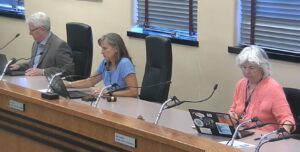
The Boulder Valley School District board voted 5-2 Tuesday night to approve its Resilient Schools plan, including the closure of Douglass Elementary and the split of its attendance area among Coal Creek, Eisenhower and Heatherwood.
The Boulder Valley School District (BVSD) board voted 5-2 Tuesday night to approve its Resilient Schools plan, including the closure of Douglass Elementary and the split of its attendance area among Coal Creek, Eisenhower and Heatherwood. The plan was met with strong opposition from parents and students in the district. The proposed changes are scheduled to take effect for the 2027-28 school year.
Board member Deann Bucher proposed an amendment to remove the Douglass closure and the related relocations of High Peaks Elementary and Community Montessori. She argued there was a “regional fallacy” in the way the maps were produced and that Douglass should be redesignated as a rural school.
“The school cannot and will never achieve the proximity enrollment numbers,” Bucher said. “Removing the school from the equation removes the only community center in the area for the past 75 years.” She compared Douglass to Niwot Elementary in St. Vrain, which she said faces similar enrollment patterns but is treated as a small rural school. She added that families near Douglass are often two-income households who left Boulder for cheaper housing and now face longer drives. The motion was seconded by board member Ana Temu Otting and audience members cheered.
Board member Alex Medler, who participated remotely, rejected the motion and said he was “not interested in playing one school off another” or in delays that would keep the status quo for another year. He said mountain schools were held out because a student from Nederland would face a 19-mile drive down Boulder Canyon and not because every lower-density school qualified as rural.
The motion failed 2-5.
Temu Otting also offered an amendment to delay Broomfield’s Birch-Kohl consolidation until December, stating that Adams 12 has a scheduled vote for October 7 to close some of its schools, including an elementary school near Birch. If that school is closed, it could change the enrollment picture for Birch Elementary. Temu Otting’s motion also failed with the same 2-5 vote.
Before the vote on the resolution, President Nicole Rajpal said a no vote would not protect students. She said Poudre School District abandoned closures under public pressure, but still had to revisit school closures at a later time with worsening budgets and less capacity. Rajpal said by voting not to close the schools, “we are actively creating a segregated school district. a school district in which students who live in neighborhoods with a lot of children or who have parents that can drive them to better resource schools will have better and more robust learning opportunities than those that cannot.”
“We will have several schools with multi-grade classrooms, schools with class sizes over 30, schools that don't have access to librarians, counselors, or a full complement of art, PE and music teachers, and schools that cannot adequately provide academic interventions without the use of virtual programming,” Rajpal said. “Not only are those conditions really unfair for our students, they are impossible for our staff.” She added, “In voting for this plan, I truly believe we are voting to provide the best learning environments for our students and staff.”
The resolution passed by a 5-2 vote with Bucher and Temu Otting voting no. Public comment earlier in the meeting included numerous Douglass students and parents who opposed the resolution because it is splitting communities.
The Boulder Valley School District (BVSD) board voted 5-2 Tuesday night to approve its Resilient Schools plan, including the closure of Douglass Elementary and the split of its attendance area among Coal Creek, Eisenhower and Heatherwood. The plan was met with strong opposition from parents and students in the district. The proposed changes are scheduled to take effect for the 2027-28 school year.
Board member Deann Bucher proposed an amendment to remove the Douglass closure and the related relocations of High Peaks Elementary and Community Montessori. She argued there was a “regional fallacy” in the way the maps were produced and that Douglass should be redesignated as a rural school.
“The school cannot and will never achieve the proximity enrollment numbers,” Bucher said. “Removing the school from the equation removes the only community center in the area for the past 75 years.” She compared Douglass to Niwot Elementary in St. Vrain, which she said faces similar enrollment patterns but is treated as a small rural school. She added that families near Douglass are often two-income households who left Boulder for cheaper housing and now face longer drives. The motion was seconded by board member Ana Temu Otting and audience members cheered.
Board member Alex Medler, who participated remotely, rejected the motion and said he was “not interested in playing one school off another” or in delays that would keep the status quo for another year. He said mountain schools were held out because a student from Nederland would face a 19-mile drive down Boulder Canyon and not because every lower-density school qualified as rural.
The motion failed 2-5.
Temu Otting also offered an amendment to delay Broomfield’s Birch-Kohl consolidation until December, stating that Adams 12 has a scheduled vote for October 7 to close some of its schools, including an elementary school near Birch. If that school is closed, it could change the enrollment picture for Birch Elementary. Temu Otting’s motion also failed with the same 2-5 vote.
Before the vote on the resolution, President Nicole Rajpal said a no vote would not protect students. She said Poudre School District abandoned closures under public pressure, but still had to revisit school closures at a later time with worsening budgets and less capacity. Rajpal said by voting not to close the schools, “we are actively creating a segregated school district. a school district in which students who live in neighborhoods with a lot of children or who have parents that can drive them to better resource schools will have better and more robust learning opportunities than those that cannot.”
“We will have several schools with multi-grade classrooms, schools with class sizes over 30, schools that don’t have access to librarians, counselors, or a full complement of art, PE and music teachers, and schools that cannot adequately provide academic interventions without the use of virtual programming,” Rajpal said. “Not only are those conditions really unfair for our students, they are impossible for our staff.” She added, “In voting for this plan, I truly believe we are voting to provide the best learning environments for our students and staff.”
The resolution passed by a 5-2 vote with Bucher and Temu Otting voting no. Public comment earlier in the meeting included numerous Douglass students and parents who opposed the resolution because it is splitting communities.