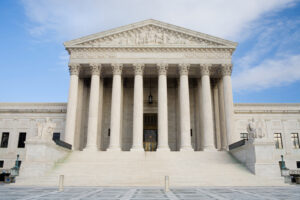
The U.S. Supreme Court opened its new term with a lawsuit brought by the City of Boulder and Boulder County against Suncor Energy and ExxonMobil
The U.S. Supreme Court opened its new term Monday with nearly two hours of argument in a lawsuit brought by the City of Boulder and Boulder County against Suncor Energy and ExxonMobil alleging the companies should be held financially responsible for costs associated with fossil fuel related climate change.
After the companies failed to move the case to federal court, a state trial court refused to dismiss it, and the Colorado Supreme Court later held that federal law does not block Boulder’s claims. The companies are now asking the U.S. Supreme Court to throw the case out, arguing that suits over interstate air and water pollution belong in federal law, not state court. The Trump administration is backing them. Principal Deputy U.S. Solicitor General Sarah Harris argued on the administration’s behalf.
Kannon Shanmugam, arguing for the gas companies, called the suit an “unprecedented effort to use state law to regulate global conduct.” He said the Constitution limits state law in inherently federal areas, that the court has long treated interstate-pollution claims as governed by federal law, and that a state cannot regulate out-of-state conduct based only on attenuated in-state effects.
Chief Justice John Roberts noted that courts often allow suits based on out-of-state conduct that has effects inside the state, and asked Harris what makes this case different. She said Colorado’s theory would effectively ban fossil-fuel production anywhere in the country. Roberts said that is a question of relief rather than a bar on bringing the lawsuit at all.
Justice Elena Kagan compared the case to 1990s tobacco litigation and more recent lawsuits against opioid manufacturers. She asked whether those claims were also preempted. Shanmugam argued that those cases were different because the injury in the Boulder suit is not suffered by a Colorado consumer in the traditional sense. He again claimed that federal law governs interstate air and water pollution. Kagan asked him for an argument based on the language in the constitution.
Kevin Russell, arguing for Boulder, said states have long provided remedies for injuries inside their borders even when the conduct occurs outside of the state. He said applying the state law is not the same as projecting it nationwide. Congress has the ability to pass new laws to preempt state laws when it chooses to do so.
Russell reiterated the point that the lawsuit is not intended as a regulation to prevent fossil fuel companies from operating, but to be financially responsible for the damage that results from the activities they conduct.
Justice Brett Kavanaugh pointed to previous cases as precedent that “make crystal-clear that interstate air and water pollution are matters for federal law” unless Congress says otherwise.
Shanmugam, during rebuttal, argued that Boulder’s theory could be used to sue a visitor who refills a gas tank in Colorado on the basis of climate harms. He acknowledged climate change as a pressing matter, but said this type of lawsuit is “the wrong way to go about resolving it.”
Samuel Alito recused himself last week without providing a reason why, but he was previously pressured to step down from the case because he owns stock in other fossil fuel companies. If a 4-4 tie occurs while voting, the Colorado Supreme Court decision is upheld.