With the inaugural festival happening this weekend, I’ve been wondering for a while why Longmont is lauded for having so much good pizza.
For a city its size, the concentration is unusual. Within a few blocks of downtown, you can find serious New York-style pizza, Detroit-style pizza, artisan pies and hybrids that are harder to classify. The people making them compete nationally, win awards and, perhaps more surprisingly, eat at each other’s restaurants.
Chef Nick Swanson has noticed it, too.
“I think what’s happening in Colorado is amazing,” Swanson told me. “I could rattle off easily five different pizzerias right now that have delicious pizza that’s worth traveling for.”
Longmont has become a particularly concentrated version of that scene. Swanson points to Urban Field, Rosalee’s and Antonio’s, all clustered downtown and making noticeably different styles.
“A lot of people think competition in the restaurant space is massive, right? And it is, in the way that it kind of elevates everyone,” he said. “When you have other people that are doing kind of similar food to what you’re doing, it really makes you stay on your A-game.”
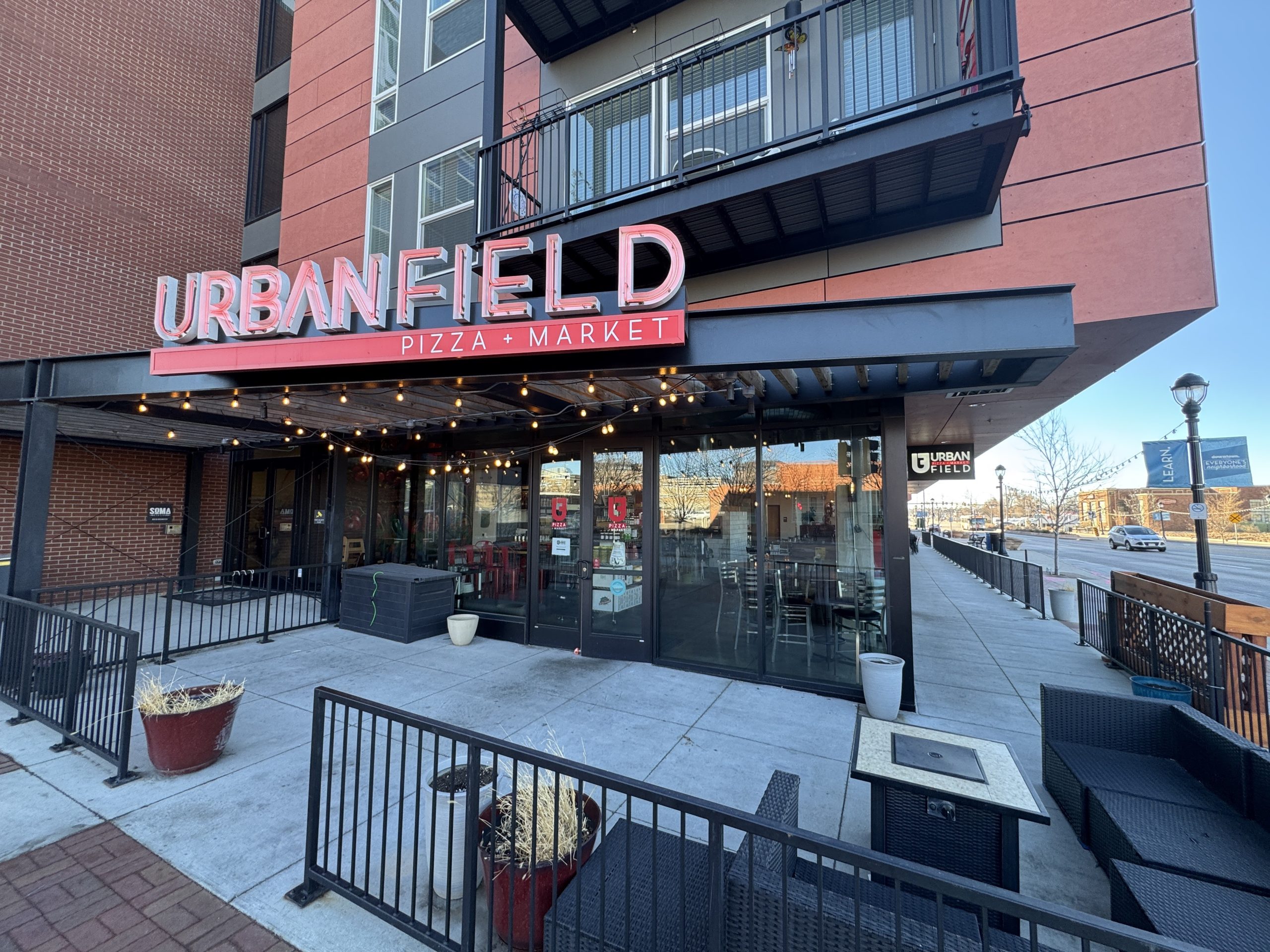
I wanted to see what that looked like behind the counter, so I went to Urban Field Pizza & Market in downtown Longmont and asked them to teach me how to make one.
Before we discussed dough, ovens or cheese, however, there was apparently something more important.
“All right, first thing we got to talk about is my pizza snowboard collection,” he said.
Urban Field has several mounted around the restaurant. Swanson pointed out one with dancing pizza slices and an Arbor snowboard released with a matching pizza cutter.
“I’m a skier, actually,” he admitted. “Not even a snowboarder, but snowboards for some reason just have cooler graphics than skis.”
As an erstwhile snowboarder, I agreed.
Then we went into the kitchen.
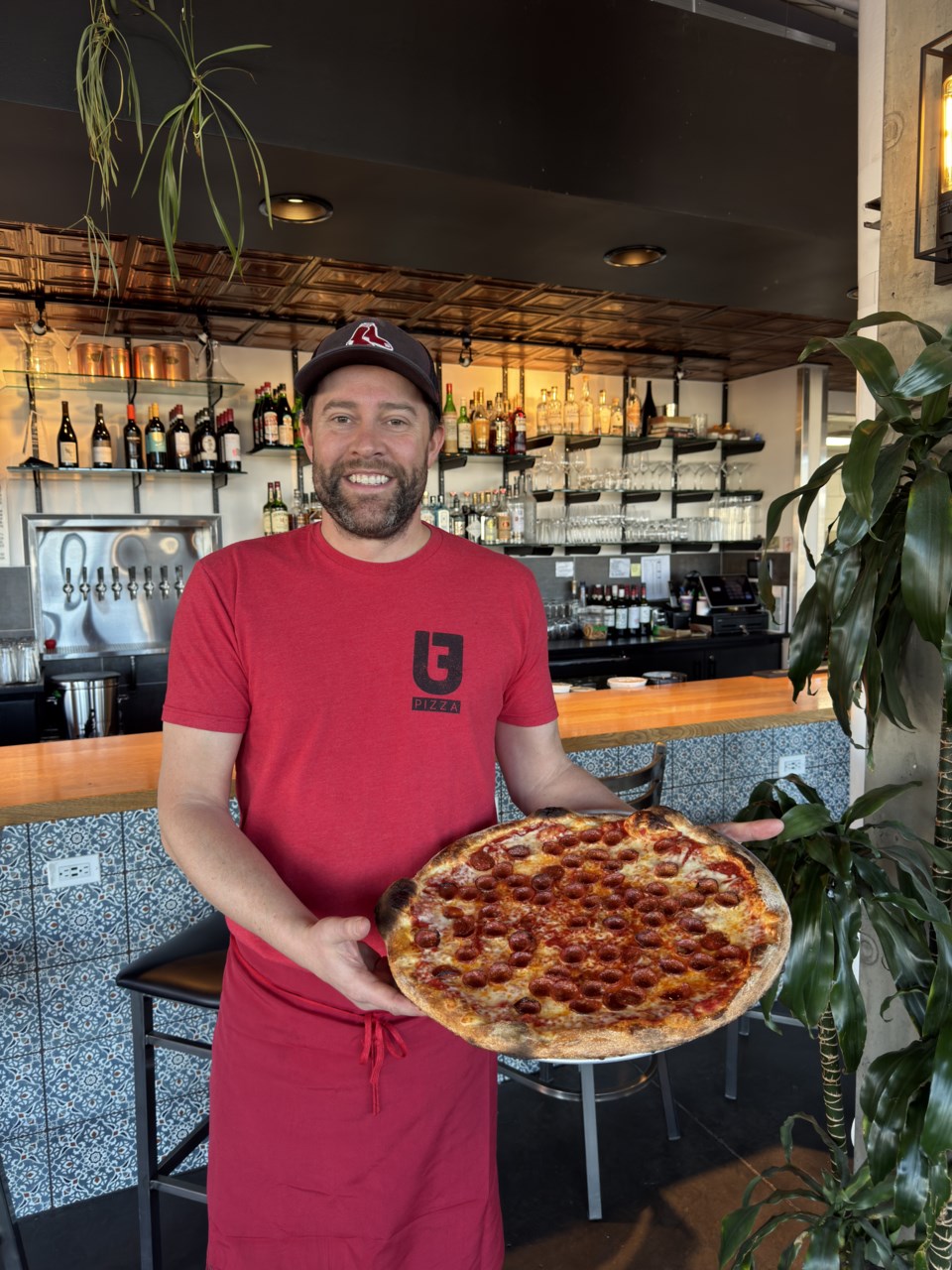
Urban Field Chef Nick Swanson. Urban Field
Swanson is not an ordinary pizza chef, approaching the global comfort food with a fine dining and gourmet perspective. When he's not coming up with new pie recipes for the restaurant, he's competing, bringing one-of-a-kind fusion pizza ideas to the International Pizza Expo in Las Vegas. His most recent was christened "Pan Division," a play on Thai laab with ground pork, shaved cucumber, pickled Fresno chili, Thai basil, mint, micro cilantro, crushed peanuts, and lime. Swanson described this as "Bánh mì in pizza form." This experimental palette is what gives Urban Field a unique profile in a town quickly becoming a destination for slices.
Like many others, it all starts with the dough.
Urban Field can turn out 200 to 250 pizzas on a normal day and more than 350 on a busy one, Swanson said. The dough starts in a large Hobart mixer before moving to a line built around a three-deck electric oven imported from Italy. He walked through stretching, topping, staging and baking, and nearly every step had its own rule.
One of the first involved doing nothing.
When a pizza comes out of the oven, Urban Field does not immediately cut it.
“It’s very, very important to rest the pizza as you would a steak,” Swanson said. The pause lets the cheese and sauce settle. Cut it too quickly and, in his words, everything can “slog out the bottom of the pie.”
Then he handed me a dough ball.
Swanson had me work around the perimeter first, keeping my hands away from the center as much as possible.
“The mistake a lot of people make is they stretch out the middle too much,” he told me. “If you stretch the middle too much in the beginning, you can’t ever get that back.”
Mine was not especially round.
“That’s how you know human hands made it,” he said.
Next came sauce, another point where my instincts quickly proved unreliable. I like sauce. Apparently I like too much sauce.
“A lot of people, I feel like, have a tendency to overtop the middle of the pie,” Swanson said. As the crust rises, toppings naturally move toward the center. Put too much there and “it’s just going to be extra soggy.”
Swanson’s attention to small details becomes most obvious when he starts talking about toppings. His favorite Urban Field pizza is the Funghi, and he has strong feelings about the typical mushroom pizza.
His complaint is familiar: red sauce, cheese and a few thin slices of mushroom scattered around.
Urban Field goes in the other direction. The Funghi uses mushroom cream sauce, fontina, roasted mushrooms and a seasoning made with dried lion’s mane mushrooms.
“Mushrooms on mushrooms on mushrooms,” Swanson said.
I told him I had generally been suspicious of mushroom pizza. He suggested the problem might be years of eating the thin canned mushrooms common on pizzas when we were growing up.
Then he made me his version.
I took a bite.
“Oh man, that’s so good,” I said.
I had to reconsider my relationship with mushrooms.
Swanson explained that preparation matters as much as the ingredient itself. Put a thick raw mushroom in the oven and it releases water as it cooks.
“Where’s all that moisture going to go?” he said. “It’s going to go on top of your pizza. So you’re kind of fighting against yourself.”
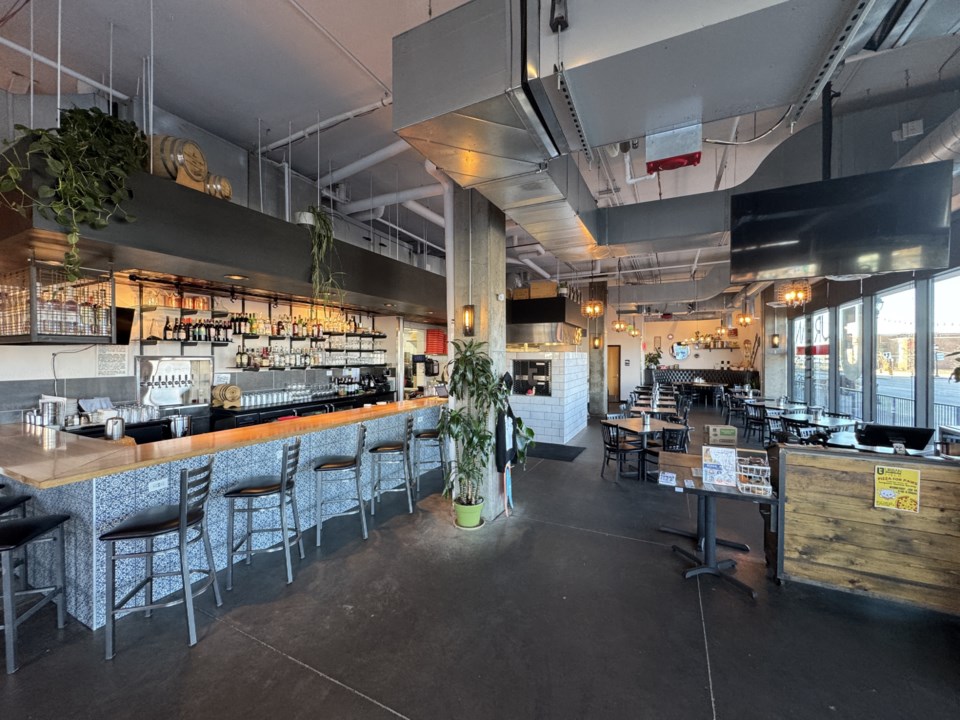
Urban Field. Urban Field
Urban Field’s square pizza follows the same approach. It resembles Detroit-style pizza, but Swanson describes it as a combination of several traditions. Detroit contributes the pan and crispy cheese edge. Sicilian technique contributes the double bake. Roman pizza contributes the high-hydration dough.
“Ours is pushing 85% hydration,” he said.
That water content creates the large air pockets and lighter interior that surprised co-owner Lindsey Beddard when she first tried Swanson’s pizza years ago.
This was during the pandemic, before Urban Field existed as a restaurant. Swanson was developing pizzas at home, and Beddard and co-owner Paul Nashak would come over to taste them.
“I remember sitting in his backyard and there were chickens running around, his kids were there,” Beddard said. “And they’re like, ‘We’re going to focus on square pizza.’ And I was like, ‘Oh, I don’t love square pizza, but I’ll try it.’”
Then she took a bite.
“I was like, ‘This is it. This is incredible.’ It was so unique and light and airy,” she said. “I will always remember the first bite of the T-Square, and that was the pizza where we were like, ‘We got this.’”
The timing, however, was less than ideal.
Urban Field was conceived during COVID-19, when the restaurant industry was being dismantled in real time. Nashak had already experienced that collapse firsthand through his previous restaurant business.
“We were all scarred from that,” he said. “I laid off 365 employees with my business partner in one morning.”
Urban Field was built with that experience in mind. Nashak found the property. Beddard developed the hospitality model. Swanson developed the food at home.
“Nick was literally cooking out of his kitchen at home,” Nashak said. “We would go over once a week and try all the various pizzas he was demoing. Finally one day he’s like, ‘I got it.’ And we tried it and I’m like, ‘Yeah, you do.’”
They opened Urban Field in phases, starting with takeout and a larger market stocked with food from local farms and businesses before opening the full dining room.
“The three of us were here from open to close every single day, trying to figure out what works, what didn’t work, how we’re going to adapt,” Beddard said.
The owners collectively had decades of restaurant experience. They still misjudged opening week.
“We showed so much hubris,” Nashak said. “We thought when we opened the doors everyone would want to check out what we were doing, and it just wasn’t the case.”
He started losing sleep. Beddard was trying to schedule employees for customers who were not there. Then, around the second and third weeks, Nashak began hearing something different when he asked diners if they had visited before.
People were coming back.
Some told him they could not stop thinking about the pizza. Others had returned with friends because they had been talking about it since their previous visit.
“We realized right out of the gates in that second week that we had emotional engagement with Nick’s pizza with our customer base,” Nashak said. “From that point on, we knew we were going to be OK.”
The economics of running a restaurant have not gotten much easier.
The National Restaurant Association estimates the average restaurant’s expenses increased 36% between 2019 and 2026. Restaurant wages rose 41% during that period and wholesale food prices increased 35%. In 2025, 42% of restaurant operators said their businesses were not profitable.
Pizza has its own pressures. The 2026 Pizza Industry Trends Report from Pizza Today estimates there were 75,736 pizzerias in the United States in 2025 generating about $49.5 billion in sales. Detroit-style pizza continues to rank among the country’s most common styles and was identified as the top trending style for 2026.
Those numbers help explain Nashak’s part of the Urban Field equation. While Swanson thinks about fermentation and Beddard focuses on hospitality, Nashak spends a lot of time thinking about square footage, labor and overhead.
His previous restaurants were often 4,000 to 6,000 square feet. Urban Field intentionally went smaller.
“We don’t really work above 3,000 feet anymore,” Nashak said. “That’s to protect our labor model. It’s to protect our overhead a little bit.”
His post-pandemic lesson is simple: “Get small, get efficient.”
Takeout became part of that model. Nashak said Urban Field quickly reached a point where roughly 45% of its daily food sales left the restaurant, allowing it to sell more food without adding the same front-of-house labor required for another occupied table.
Beddard points to the other side of the equation. Efficiency only gets them so far if they want to use expensive ingredients.
“The flour, the cheese, the pepperoni, the olive oil,” she said. “If you use good ingredients, it’s not cheap.”
Labor remains another challenge.
“It’s not easy,” Beddard said. “We’re really lucky because we have each other. There’s always something going on, but one of us has a good handle on how to solve it.”
Urban Field went from a few owners and no employees to about 80 employees as the group opened three restaurants in 36 months, Nashak said. Beddard said the challenge is finding people who are proud of where they work, the food they serve and “the sort of hospitality we’re giving.”
At the same time, the restaurant’s local focus has grown rather than faded. Beddard stocked Urban Field’s original market with products from roughly 100 local companies, Nashak said. The owners talk about nearby farms, producers and neighboring restaurants often enough that the distinction between competition and community gets blurry.
That becomes especially relevant in September.
Urban Field, Rosalee’s and Antonio’s have formed a nonprofit called Pizza With Purpose. The organization grew out of an Urban Field food drive after one of the restaurant’s managers became concerned about families facing the potential loss of SNAP benefits.
Nashak told him to act.
“We had a food bank open within three days,” he said.
Nashak said donations ultimately helped 170 families. Swanson was competing in Florida at the time when he called Nashak.
“He goes, ‘I got it. It’s Pizza With Purpose,’” Nashak recalled. “And I’m like, ‘What’s Pizza With Purpose?’ He’s like, ‘I don’t know, I got to go though.’”
By the time Swanson returned, Nashak said, the nonprofit had been created.
Beddard said the philanthropic work began long before that. Urban Field has regularly selected a school or nonprofit to receive 10% of sales during a designated Wednesday.
“It’s really important for us to give back to the community that we’re in,” she said.
Pizza With Purpose’s biggest project so far arrives this weekend on Sept. 5, when the inaugural Colorado Pizza Festival is scheduled to take over Fourth Avenue and Kimbark Street in downtown Longmont. The event is set for 1 to 10 p.m. and lists more than 20 Colorado pizzerias, along with live music and local drinks. Proceeds are slated to benefit Slice Out Hunger, Longmont Food Rescue, Community Food Share and Colorado Friendship.
The festival also brings me back to the question that started all of this.
Why Longmont?
For Beddard, the answer is personal.
“This is home,” she said. “We wanted to be in the community that we call home.”
Nashak, who handled the property search, has a business answer. The group looked at locations from northern Denver through northern Longmont before choosing downtown.
“Longmont’s food scene is the best on the Front Range, and I can’t really explain that,” he said. “At a crucial time, it attracted great restaurateurs and very clever restaurateurs.”
He also credits the Longmont Downtown Development Authority with helping the group navigate the process and access grants.
“The food scene up here, to me, rivals Boulder, rivals almost Denver at this point,” he said.
The Colorado Pizza Festival will put that claim in front of a much larger audience.
Beddard said she is looking forward to seeing people gather around something simple and familiar.
“Everybody wants, like, breaking bread,” she said. “You’re having something that is special to you and your whole community. So I think that’s going to be awesome.”
For Nashak, that is ultimately the point of restaurants.
“I’ve always loved food and hospitality, but it’s not been about slinging beers and food for me,” he said. “It was about building community.”
By then, my own pizza was finally in the oven.
Swanson had coached me through the launch. “First things first, don’t burn yourself,” he advised, which was among the more practical instructions of the evening.
Then I had to rotate the pizza while keeping it on the same section of stone. Move it onto a hotter section, Swanson explained, and the bottom could burn before the rest finished cooking.
After some nervous maneuvering, I got it out.
Swanson lifted the edge and inspected the bottom.
“Great undercarriage,” he said.
It was probably the first time anyone had complimented my undercarriage.
My pizza was not perfect. I had gone too hard on the sauce. I had already been warned about my sauce problem, but it was a more robust and spicy version of a traditional pizza sauce. I wanted that sauce.
Despite my lack of experience, it was so good.
By the end of the visit, that seemed like the useful answer to my original question. There is no single reason Longmont’s pizza scene has gotten so good. Swanson talks about competition making everyone better. Beddard talks about employees, hospitality and investing in the place where you live. Nashak talks about keeping costs under control so a restaurant can survive long enough to become part of that place.
The American pizza business is enormous, crowded and dealing with the same labor, food-cost and consumer-spending pressures hitting restaurants everywhere. Urban Field’s answer is distinctly local: smaller restaurants, good ingredients, lots of takeout, employees they trust, neighboring pizzerias they consider friends and, come September, a downtown festival built around feeding people.
As I was leaving, Nashak asked whether I wanted another pizza to take home.
“One with less sauce?”
I feel like it will still take me a while to get that one right.
With the inaugural festival happening this weekend, I’ve been wondering for a while why Longmont is lauded for having so much good pizza.
For a city its size, the concentration is unusual. Within a few blocks of downtown, you can find serious New York-style pizza, Detroit-style pizza, artisan pies and hybrids that are harder to classify. The people making them compete nationally, win awards and, perhaps more surprisingly, eat at each other’s restaurants.
Chef Nick Swanson has noticed it, too.
“I think what’s happening in Colorado is amazing,” Swanson told me. “I could rattle off easily five different pizzerias right now that have delicious pizza that’s worth traveling for.”
Longmont has become a particularly concentrated version of that scene. Swanson points to Urban Field, Rosalee’s and Antonio’s, all clustered downtown and making noticeably different styles.
“A lot of people think competition in the restaurant space is massive, right? And it is, in the way that it kind of elevates everyone,” he said. “When you have other people that are doing kind of similar food to what you’re doing, it really makes you stay on your A-game.”
I wanted to see what that looked like behind the counter, so I went to Urban Field Pizza & Market in downtown Longmont and asked them to teach me how to make one.
Before we discussed dough, ovens or cheese, however, there was apparently something more important.
“All right, first thing we got to talk about is my pizza snowboard collection,” he said.
Urban Field has several mounted around the restaurant. Swanson pointed out one with dancing pizza slices and an Arbor snowboard released with a matching pizza cutter.
“I’m a skier, actually,” he admitted. “Not even a snowboarder, but snowboards for some reason just have cooler graphics than skis.”
As an erstwhile snowboarder, I agreed.
Then we went into the kitchen.
Urban Field Chef Nick Swanson. Urban Field
Swanson is not an ordinary pizza chef, approaching the global comfort food with a fine dining and gourmet perspective. When he’s not coming up with new pie recipes for the restaurant, he’s competing, bringing one-of-a-kind fusion pizza ideas to the International Pizza Expo in Las Vegas. His most recent was christened “Pan Division,” a play on Thai laab with ground pork, shaved cucumber, pickled Fresno chili, Thai basil, mint, micro cilantro, crushed peanuts, and lime. Swanson described this as “Bánh mì in pizza form.” This experimental palette is what gives Urban Field a unique profile in a town quickly becoming a destination for slices.
Like many others, it all starts with the dough.
Urban Field can turn out 200 to 250 pizzas on a normal day and more than 350 on a busy one, Swanson said. The dough starts in a large Hobart mixer before moving to a line built around a three-deck electric oven imported from Italy. He walked through stretching, topping, staging and baking, and nearly every step had its own rule.
One of the first involved doing nothing.
When a pizza comes out of the oven, Urban Field does not immediately cut it.
“It’s very, very important to rest the pizza as you would a steak,” Swanson said. The pause lets the cheese and sauce settle. Cut it too quickly and, in his words, everything can “slog out the bottom of the pie.”
Then he handed me a dough ball.
Swanson had me work around the perimeter first, keeping my hands away from the center as much as possible.
“The mistake a lot of people make is they stretch out the middle too much,” he told me. “If you stretch the middle too much in the beginning, you can’t ever get that back.”
Mine was not especially round.
“That’s how you know human hands made it,” he said.
Next came sauce, another point where my instincts quickly proved unreliable. I like sauce. Apparently I like too much sauce.
“A lot of people, I feel like, have a tendency to overtop the middle of the pie,” Swanson said. As the crust rises, toppings naturally move toward the center. Put too much there and “it’s just going to be extra soggy.”
Swanson’s attention to small details becomes most obvious when he starts talking about toppings. His favorite Urban Field pizza is the Funghi, and he has strong feelings about the typical mushroom pizza.
His complaint is familiar: red sauce, cheese and a few thin slices of mushroom scattered around.
Urban Field goes in the other direction. The Funghi uses mushroom cream sauce, fontina, roasted mushrooms and a seasoning made with dried lion’s mane mushrooms.
“Mushrooms on mushrooms on mushrooms,” Swanson said.
I told him I had generally been suspicious of mushroom pizza. He suggested the problem might be years of eating the thin canned mushrooms common on pizzas when we were growing up.
Then he made me his version.
I took a bite.
“Oh man, that’s so good,” I said.
I had to reconsider my relationship with mushrooms.
Swanson explained that preparation matters as much as the ingredient itself. Put a thick raw mushroom in the oven and it releases water as it cooks.
“Where’s all that moisture going to go?” he said. “It’s going to go on top of your pizza. So you’re kind of fighting against yourself.”
Urban Field. Urban Field
Urban Field’s square pizza follows the same approach. It resembles Detroit-style pizza, but Swanson describes it as a combination of several traditions. Detroit contributes the pan and crispy cheese edge. Sicilian technique contributes the double bake. Roman pizza contributes the high-hydration dough.
“Ours is pushing 85% hydration,” he said.
That water content creates the large air pockets and lighter interior that surprised co-owner Lindsey Beddard when she first tried Swanson’s pizza years ago.
This was during the pandemic, before Urban Field existed as a restaurant. Swanson was developing pizzas at home, and Beddard and co-owner Paul Nashak would come over to taste them.
“I remember sitting in his backyard and there were chickens running around, his kids were there,” Beddard said. “And they’re like, ‘We’re going to focus on square pizza.’ And I was like, ‘Oh, I don’t love square pizza, but I’ll try it.’”
Then she took a bite.
“I was like, ‘This is it. This is incredible.’ It was so unique and light and airy,” she said. “I will always remember the first bite of the T-Square, and that was the pizza where we were like, ‘We got this.’”
The timing, however, was less than ideal.
Urban Field was conceived during COVID-19, when the restaurant industry was being dismantled in real time. Nashak had already experienced that collapse firsthand through his previous restaurant business.
“We were all scarred from that,” he said. “I laid off 365 employees with my business partner in one morning.”
Urban Field was built with that experience in mind. Nashak found the property. Beddard developed the hospitality model. Swanson developed the food at home.
“Nick was literally cooking out of his kitchen at home,” Nashak said. “We would go over once a week and try all the various pizzas he was demoing. Finally one day he’s like, ‘I got it.’ And we tried it and I’m like, ‘Yeah, you do.’”
They opened Urban Field in phases, starting with takeout and a larger market stocked with food from local farms and businesses before opening the full dining room.
“The three of us were here from open to close every single day, trying to figure out what works, what didn’t work, how we’re going to adapt,” Beddard said.
The owners collectively had decades of restaurant experience. They still misjudged opening week.
“We showed so much hubris,” Nashak said. “We thought when we opened the doors everyone would want to check out what we were doing, and it just wasn’t the case.”
He started losing sleep. Beddard was trying to schedule employees for customers who were not there. Then, around the second and third weeks, Nashak began hearing something different when he asked diners if they had visited before.
People were coming back.
Some told him they could not stop thinking about the pizza. Others had returned with friends because they had been talking about it since their previous visit.
“We realized right out of the gates in that second week that we had emotional engagement with Nick’s pizza with our customer base,” Nashak said. “From that point on, we knew we were going to be OK.”
The economics of running a restaurant have not gotten much easier.
The National Restaurant Association estimates the average restaurant’s expenses increased 36% between 2019 and 2026. Restaurant wages rose 41% during that period and wholesale food prices increased 35%. In 2025, 42% of restaurant operators said their businesses were not profitable.
Pizza has its own pressures. The 2026 Pizza Industry Trends Report from Pizza Today estimates there were 75,736 pizzerias in the United States in 2025 generating about $49.5 billion in sales. Detroit-style pizza continues to rank among the country’s most common styles and was identified as the top trending style for 2026.
Those numbers help explain Nashak’s part of the Urban Field equation. While Swanson thinks about fermentation and Beddard focuses on hospitality, Nashak spends a lot of time thinking about square footage, labor and overhead.
His previous restaurants were often 4,000 to 6,000 square feet. Urban Field intentionally went smaller.
“We don’t really work above 3,000 feet anymore,” Nashak said. “That’s to protect our labor model. It’s to protect our overhead a little bit.”
His post-pandemic lesson is simple: “Get small, get efficient.”
Takeout became part of that model. Nashak said Urban Field quickly reached a point where roughly 45% of its daily food sales left the restaurant, allowing it to sell more food without adding the same front-of-house labor required for another occupied table.
Beddard points to the other side of the equation. Efficiency only gets them so far if they want to use expensive ingredients.
“The flour, the cheese, the pepperoni, the olive oil,” she said. “If you use good ingredients, it’s not cheap.”
Labor remains another challenge.
“It’s not easy,” Beddard said. “We’re really lucky because we have each other. There’s always something going on, but one of us has a good handle on how to solve it.”
Urban Field went from a few owners and no employees to about 80 employees as the group opened three restaurants in 36 months, Nashak said. Beddard said the challenge is finding people who are proud of where they work, the food they serve and “the sort of hospitality we’re giving.”
At the same time, the restaurant’s local focus has grown rather than faded. Beddard stocked Urban Field’s original market with products from roughly 100 local companies, Nashak said. The owners talk about nearby farms, producers and neighboring restaurants often enough that the distinction between competition and community gets blurry.
That becomes especially relevant in September.
Urban Field, Rosalee’s and Antonio’s have formed a nonprofit called Pizza With Purpose. The organization grew out of an Urban Field food drive after one of the restaurant’s managers became concerned about families facing the potential loss of SNAP benefits.
Nashak told him to act.
“We had a food bank open within three days,” he said.
Nashak said donations ultimately helped 170 families. Swanson was competing in Florida at the time when he called Nashak.
“He goes, ‘I got it. It’s Pizza With Purpose,’” Nashak recalled. “And I’m like, ‘What’s Pizza With Purpose?’ He’s like, ‘I don’t know, I got to go though.’”
By the time Swanson returned, Nashak said, the nonprofit had been created.
Beddard said the philanthropic work began long before that. Urban Field has regularly selected a school or nonprofit to receive 10% of sales during a designated Wednesday.
“It’s really important for us to give back to the community that we’re in,” she said.
Pizza With Purpose’s biggest project so far arrives this weekend on Sept. 5, when the inaugural Colorado Pizza Festival is scheduled to take over Fourth Avenue and Kimbark Street in downtown Longmont. The event is set for 1 to 10 p.m. and lists more than 20 Colorado pizzerias, along with live music and local drinks. Proceeds are slated to benefit Slice Out Hunger, Longmont Food Rescue, Community Food Share and Colorado Friendship.
The festival also brings me back to the question that started all of this.
Why Longmont?
For Beddard, the answer is personal.
“This is home,” she said. “We wanted to be in the community that we call home.”
Nashak, who handled the property search, has a business answer. The group looked at locations from northern Denver through northern Longmont before choosing downtown.
“Longmont’s food scene is the best on the Front Range, and I can’t really explain that,” he said. “At a crucial time, it attracted great restaurateurs and very clever restaurateurs.”
He also credits the Longmont Downtown Development Authority with helping the group navigate the process and access grants.
“The food scene up here, to me, rivals Boulder, rivals almost Denver at this point,” he said.
The Colorado Pizza Festival will put that claim in front of a much larger audience.
Beddard said she is looking forward to seeing people gather around something simple and familiar.
“Everybody wants, like, breaking bread,” she said. “You’re having something that is special to you and your whole community. So I think that’s going to be awesome.”
For Nashak, that is ultimately the point of restaurants.
“I’ve always loved food and hospitality, but it’s not been about slinging beers and food for me,” he said. “It was about building community.”
By then, my own pizza was finally in the oven.
Swanson had coached me through the launch. “First things first, don’t burn yourself,” he advised, which was among the more practical instructions of the evening.
Then I had to rotate the pizza while keeping it on the same section of stone. Move it onto a hotter section, Swanson explained, and the bottom could burn before the rest finished cooking.
After some nervous maneuvering, I got it out.
Swanson lifted the edge and inspected the bottom.
“Great undercarriage,” he said.
It was probably the first time anyone had complimented my undercarriage.
My pizza was not perfect. I had gone too hard on the sauce. I had already been warned about my sauce problem, but it was a more robust and spicy version of a traditional pizza sauce. I wanted that sauce.
Despite my lack of experience, it was so good.
By the end of the visit, that seemed like the useful answer to my original question. There is no single reason Longmont’s pizza scene has gotten so good. Swanson talks about competition making everyone better. Beddard talks about employees, hospitality and investing in the place where you live. Nashak talks about keeping costs under control so a restaurant can survive long enough to become part of that place.
The American pizza business is enormous, crowded and dealing with the same labor, food-cost and consumer-spending pressures hitting restaurants everywhere. Urban Field’s answer is distinctly local: smaller restaurants, good ingredients, lots of takeout, employees they trust, neighboring pizzerias they consider friends and, come September, a downtown festival built around feeding people.
As I was leaving, Nashak asked whether I wanted another pizza to take home.
“One with less sauce?”
I feel like it will still take me a while to get that one right.
About the Author:
Alex Delia
Alex Delia is the managing editor of The Longmont Leader, where he oversees daily news coverage across Longmont and Boulder County, shaping editorial strategy, assigning...