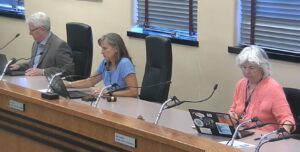
A decision is expected within one to two weeks.
After a two-hour hearing Thursday, Judge Dea M. Lindsey issued a stay until she decides whether to temporarily block the district’s Resilient Schools plan. She said she wanted time to review district documents and recordings of meetings and presentations, called the case her priority, and said a ruling should come in one to two weeks.
The lawsuit was filed September 30 by parents Evan Harvie, Katharine Rosenthal, and Theresa Schultz. Their children attend Douglass, Flatirons, and Mesa elementary schools. On September 22 the school board voted 5–2 to close those three Boulder schools and Birch Elementary in Broomfield, move two focus schools, and change the grades at two K–8 schools. The changes would take effect in fall 2027.
The parents, represented by Eric Maxfield, are not asking the court to decide which schools should stay open. They say the board shaped the plan out of public view, in violation of Colorado’s Open Meetings Law. They want the district stopped from locking in student assignments and other hard-to-reverse steps while the case continues.
The district’s October 6 response says the process was public and that a court order is unnecessary. Enrollment has fallen by 3,675 students since 2017, and the district expects to lose another 1,670 by 2030. At a public work session on October 21, 2025, board members concluded that dealing with shrinking schools one at a time would not be enough. They told staff to look at the problem by region and to ask the community for input. No formal vote was taken that day. The district says that change in approach was repeated at later public meetings and during months of outreach.
There is a strong disagreement between the district and the parents regarding the purpose of the outreach. From January through May, the district held staff roundtables, community sessions, and city-council presentations. It collected survey responses on what families wanted if schools had to change. The parents’ motion argued that the spring sessions were not a chance to comment on the proposal the board later adopted, because that proposal did not yet exist.
In its response, the district fired back: “Plaintiffs assert, rather boldly, that the District’s multi-month community-outreach process this past spring was meaningless and ‘wasn’t designed to get feedback on the actual Proposal it was cooking up in secret.’ That is demonstrably untrue.” Staff say they used that feedback when they wrote the proposal over the summer, and that board members did not learn which schools would be affected until early August.
A June 16 board meeting moved the final vote up to September 22 so families would have more time before choice enrollment. In early August, Superintendent Rob Anderson and Assistant Superintendent Rob Price walked board members through the draft in small meetings, usually two members at a time. The district says members asked questions, did not talk the plan over with one another, and did not say how they would vote. The proposal was released at a public meeting on August 25. The board took public comment, held a study session, and voted 5–2 on September 22. The district argues that any problem with the process can be fixed before the doors close in May 2027.
The parents’ October 7 reply says those same facts show the problem. If the October 21 meeting really produced a decision to drop the district’s old early-warning process for struggling schools, the agenda did not say that. It described an update on enrollment and a report from the Long Range Advisory Committee. The parents say if the decision wasn’t made during that meeting, it was made somewhere else. They also say the district promised the public several options and a chance to comment on them before a final plan was chosen, but they skipped that step.
The August briefings are the other main dispute. The parents say Anderson and Price took a secret proposal to the full board through a series of small meetings so members could review it before anyone else saw it. They argue that the law covers how policy is formed, not only the final vote.
On whether the court should step in now, the parents say the district has overstated the urgency. They point to the district’s October 21 materials, which they say forecast only one school entering the old engagement process by 2027, and three by 2029, if nothing changed. “This is hardly the doomsday scenario relied on by the Board to support immediate action on the Proposal,” the reply says. “If implementation proceeds and Plaintiffs prevail only after assignments, staffing, enrollment, programs, and facilities have materially changed, their statutory victory will be rendered largely hollow.”
Judge Lindsey’s stay does not decide who is right, but a decision is expected within one to two weeks.